Platform
An audit-chain-native AI HFT platform, end to end.
Every section below describes a commitment that is either landed in code today or specified as a binding architectural shape with the build window on the roadmap. Surfaces marked "on the roadmap" are not shipping today; they are designed-for and citable in the platform's internal specifications.
1 — AI HFT Architecture · Two Loops
Slow-loop AI reasons. Hot-path C++ executes at HFT speeds.
The platform separates strategic reasoning from order execution. The slow loop is Python — the AI brain. It consumes market data, computes indicators, and calls large-language-model reasoners — Anthropic Claude and Google Gemini behind a pluggable provider abstraction — to produce structured signals at seconds-to-minutes cadence. Today that loop runs in supervised paper trading; production cutover follows the platform's validation gates. The hot path is C++ — the HFT engine. It consumes those signals, validates against per-tenant risk gates, and routes orders in microseconds-to-milliseconds. No language-model call ever happens on the order path; every order passes the pre-trade risk gateway.
The boundary between the two loops is ZeroMQ with Cap'n Proto serialization, ECDSA-P256-signed. Signals carry a parameter-set provenance hash that binds the live decision back to the substrate that validated the parameters. The two loops are designed to be independently auditable: the slow loop produces a glass-box AI decision; the hot path produces a deterministic execution record. The audit chain captures both.
2 — Glass-Box AI Decisioning
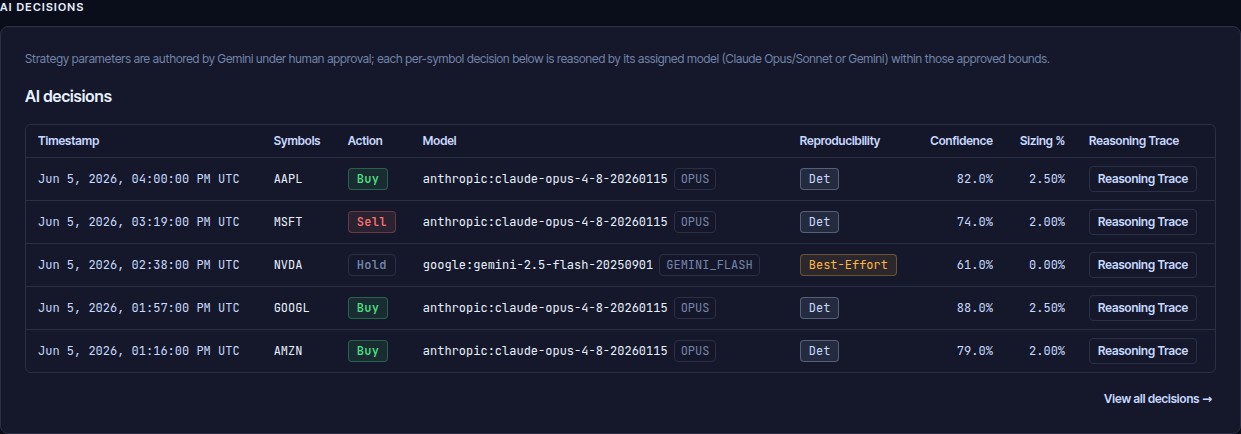
The AI is a glass box. Every decision shows its work.
Every AI decision in the platform — strategy selection, parameter choice, signal generation, lot disposition, dividend timing, and any future AI-driven decision surface — is audit-chain traced at the moment of decision. The invariant is enforced through a dedicated producer-ID and a hundred-event audit type range. Every inference emits a "started" event carrying the prompt context, model identifier, sampling temperature, and a SHA-256 of the canonical inputs. Every completion emits the output, reasoning, and the seed (or a sentinel for providers that don't expose seeds) along with a reproducibility-class discriminator.
Strategy logic is glass-box for the same reason: open code, named parameters, reproducible backtests bound to the audit chain. Black-box decisioning — for AI inferences and for strategy logic alike — is forbidden by the platform's invariant set, not by policy.
Prompts and outputs above a threshold are sidecar-stored, with the in-band event carrying a SHA-256 hash to bind the sidecar payload. The Replay API reconstructs the full forensic walk-back from the chain alone. A regulator, a tax adviser, or a forensic auditor can see what the model knew, what it decided, and why — years after the original event.
3 — 17a-4-Aligned Audit Chain
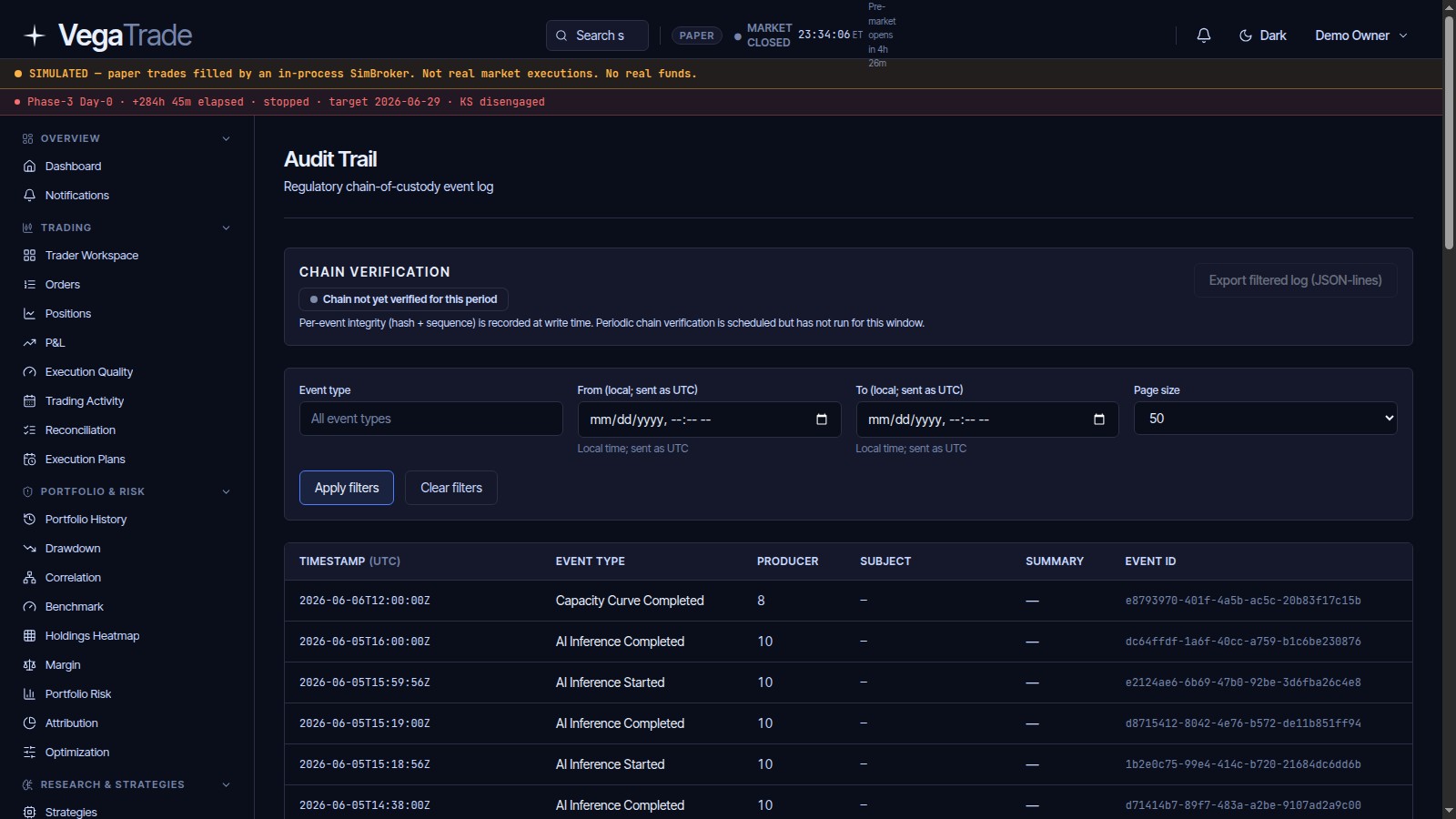
WORM-style, hash-chained, daily-root signed.
The audit service is a Go consumer of a C++ lock-free shared-memory ring. Every event is decoded, canonicalized, hash-chained per row, and written atomically to a per-tenant partitioned event store. Each tenant has its own regulatory chain; cross-tenant queries are forbidden at the database boundary, not by application filter.
The chain root is signed once per day in a hardware security module using ECDSA-P256 with RFC 6979 deterministic-k. Signed roots and chain segments are archived to an immutable WORM blob store with a seven-year retention window. The Replay API returns byte-identical event streams from cold storage. Chain integrity is verified at insert time and on a scheduled cadence; quarantined events are anchored to a dual-event self-emission for forensic reconstruction.
Architectural alignment to SEC Rule 17a-4 recordkeeping standards is the design target. Architectural alignment is not regulatory approval; the platform is not currently registered as a broker-dealer or investment adviser.
4 — Assurance Posture
Evidence mapped at the architectural level.
The audit-chain integrity invariants, daily-root HSM-signing discipline, per-tenant database isolation, encryption-at-rest in Azure Key Vault, encryption-in-transit via TLS, RBAC on every privileged surface, and the chain-of-custody token on every order are mapped to the SOC 2 Trust Services Criteria at the architectural level. The mapping is operator-runbook-documented and reviewable by a third-party auditor as soon as the production deploy window opens.
The platform is pre-launch; the production deploy is local-first today and trigger-deferred until the first concrete operational event — a paying customer commitment, a SOC 2 audit window, a penetration-test engagement, multi-developer collaboration, or a live-capital cutover. Once the deploy window opens, the SOC 2 evidence-collection cadence opens with it. The architectural evidence is in place now; the third-party attestation is on the timeline of the deploy.
The institutional procurement conversation is the right surface for the detailed evidence map. The platform's contact form is the entry point.
5 — Institutional Thick-Native Client
Designed for: on the roadmap.
Institutional clients receive a signed, code-signed desktop binary for Windows, macOS, and Linux. The thick client runs strategy logic and data-intensive computation locally — the C++ engine ships in-process — and talks to the VegaTrade regulated backbone for execution, audit-chain emission, and shared state.
The client never touches a broker directly. Order routing, audit emission, promote-to-paper verdicts, and cross-tenant analytics all terminate at the server-authoritative backbone. The client's value is local compute, multi-monitor keyboard discipline, and offline-degraded resilience — the workflow vocabulary professional traders expect from a desktop application.
Every install and every update emits an audit event carrying the binary hash, the installer signature subject, and the originating IP and geolocation. The forensic story — "show me everything this user did in this session" — runs end to end, byte-identical, replayable.
The architecture is specified. The binary is on the roadmap. The contact form is the entry point to discuss timing.
6 — Kill Switch + Risk Gateway
Global halt in under 100 milliseconds. Signed. Audit-trailed.
Every order in the platform passes through a per-tenant risk gateway in the C++ hot path before it can reach a broker. The gateway enforces position-size limits, daily-drawdown stops, order-rate caps, ticker whitelists, and the global kill switch. The gateway is the sole order path; bypassing it is architecturally impossible.
The kill switch propagates over a signed control channel — ECDSA-P256 signatures with epoch + scope + heartbeat — so a hostile signal that attempts to spoof a kill-switch engage or to suppress a real one is rejected at the subscriber. An operator-issued global halt reaches every fast-loop component in under 100 milliseconds with audit-chain attribution that records the issuing operator, the geolocation of the engagement, and the chain-of-custody of every order that was in flight.
The kill switch is not a single button; it is an architectural invariant with control-channel signing, staleness watchdog, and a state-file fallback so a kill-switch engagement survives a process restart. Every engagement and disengagement emits an audit event. Every dropped or stale control message emits an audit event. The forensic record of who stopped the platform when — and why — is complete.
7 — IP and Geolocation Logging
Every privileged action, geo-attributable.
Privileged actions — authentication events, trade executions, administrative actions, tax-lot dispositions — are designed to be geo-attributable through the audit chain: the originating IP address and a derived geolocation (country, region, city, lat/lon at city-centroid precision) are captured on the originating action event, and downstream events join to it by chain reference. Capture is specified as non-optional; events that fail attribution are quarantined, not dropped.
The same specification slice defines capture-time anomaly flags — VPN detection, Tor exit node, datacenter IP, impossible travel, country change since last session — with downstream alerting and response policy owner-decidable per tenant. These detections are on the roadmap as part of the security-telemetry slice; the contact form is the entry point to discuss timing.
The capture shape is binding at the audit-event-shape level. Storage details, retention specifics, and the geo provider selection are deferred to the security-telemetry specification slice. The shape exists now so every future privileged action emits the same forensic payload.
8 — Strategy Validity Gates + Publishing Discipline
Walk-forward, nested CV, deflated Sharpe, PBO — before paper.
Every strategy clears a validity-invariant gate set before paper trading, let alone live capital. The gates are walk-forward cross-validation (out-of-sample window slides forward in time), nested k-fold inner cross-validation (hyperparameter selection without peeking), deflated Sharpe ratio (correcting for the multiple-testing inflation that makes naive Sharpe meaningless), and probability-of-backtest-overfitting (a combinatorially symmetric cross-validation).
Execution-model fidelity bands quantify the cost the backtest charges. Research-grade is per-share commission plus linear-in-participation slippage; full-fidelity (on the roadmap) consumes Level-2 book depth. The substrate-to-live parameter-set provenance discipline binds the parameters that cleared the gate to the parameters running in production via the audit-chain head hash.
The platform publishes both gross-of-fee Sharpe and net-of-all-fees Sharpe. Tax-aware strategies — tax-loss harvesting, direct indexing — additionally publish pre-tax Sharpe and after-tax Sharpe at the user's marginal-rate assumption. The fiduciary number is the net-of-fees, after-tax Sharpe; the gross number is published only for marketing-comparison transparency, never as the headline. Live monitoring tracks the rolling Sharpe against the validated DSR and triggers retirement review on sustained breach.
The framework is built. The first AI-tuned strategy on it is on the roadmap.
9 — Backtest-to-Live Divergence
Your backtest is provably the same as what live production sees.
The substrate that validates a strategy and the engine that runs it in production are the same code paths. The audit-chain replay framework reconstructs a backtest run byte-identical to the original — same fills, same chain hashes, same outcomes — from the audit chain alone. The promote-to-paper gate requires this byte-equality as an architectural precondition.
Once a strategy is live, the platform tracks the divergence between the backtest-projected fills and the live-observed fills as a continuous metric. The divergence threshold is class-specific; a sustained breach triggers automated retirement review. Crowding, regime shift, and execution drift surface as quantified deltas, not as gut feeling.
10 — Supervised AI Strategy Authoring
The AI proposes. A human approves. The chain remembers both.
Strategy authoring on the platform is a supervised lifecycle, not an autonomous loop. An AI reasoner authors a bounded strategy parameterization — named parameters inside a constrained grammar, never free-form code — and the proposal lands in an approval queue as a pending row with its authorship recorded as AI-authored at the storage layer, fail-closed. A human operator approves it into draft or rejects it; the approval decision, the approver's identity, and the disposition all become audit-chain events.
The same discipline extends to market context: a news-monitoring pipeline can propose strategy adjustments from headline flow, and it is propose-only by construction — no news-driven path can actuate an order. Every per-symbol trading decision then runs inside the approved bounds, with its own reasoning trace captured per the glass-box invariant in §2.
Human-authored strategies travel the identical pipeline with authorship attributed from the authenticated session — so the audit chain can always answer who (or what) wrote a strategy, who approved it, and what it was allowed to do.
11 — The Operator Console
Seventy-four surfaces. One workspace.
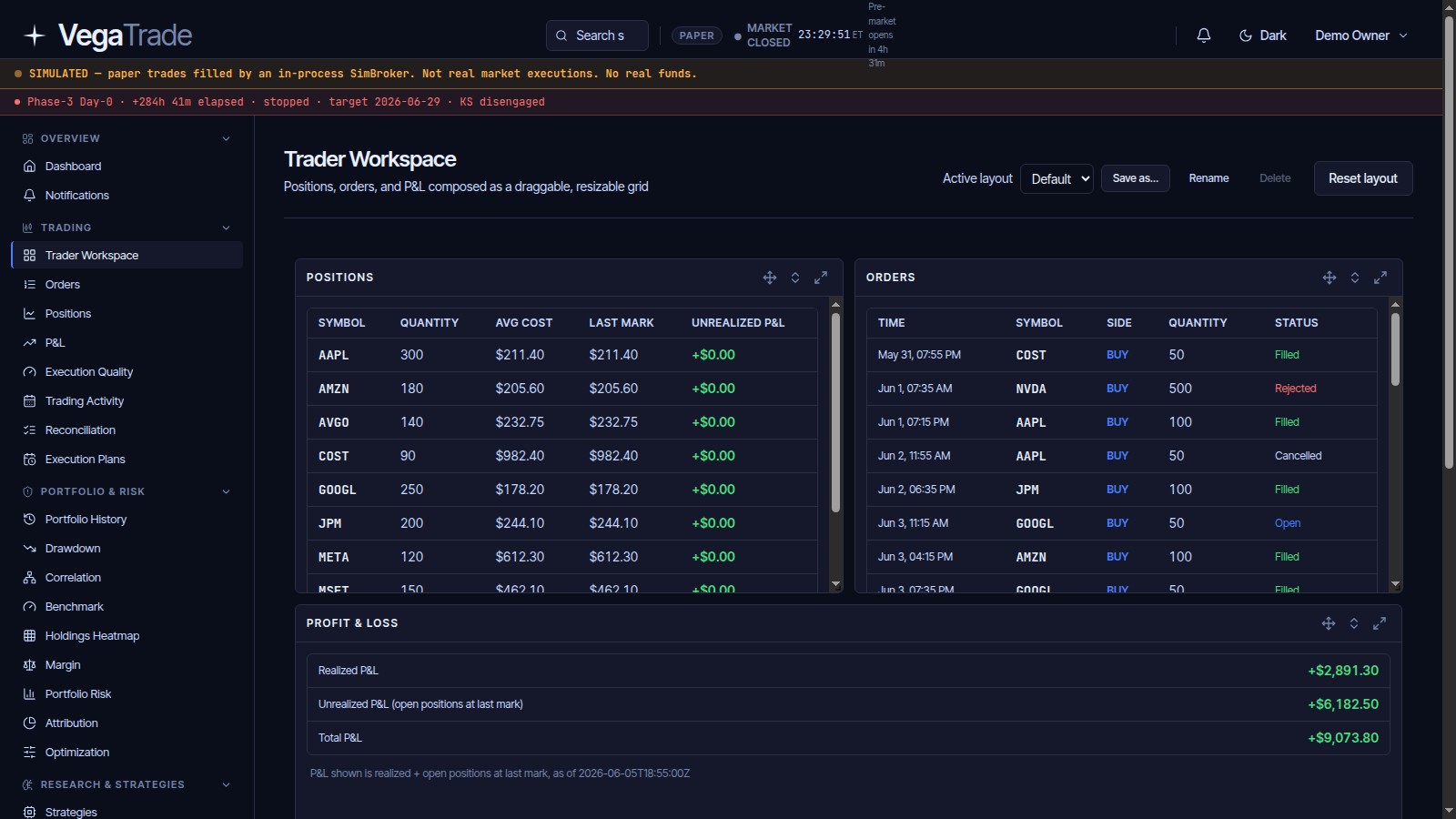
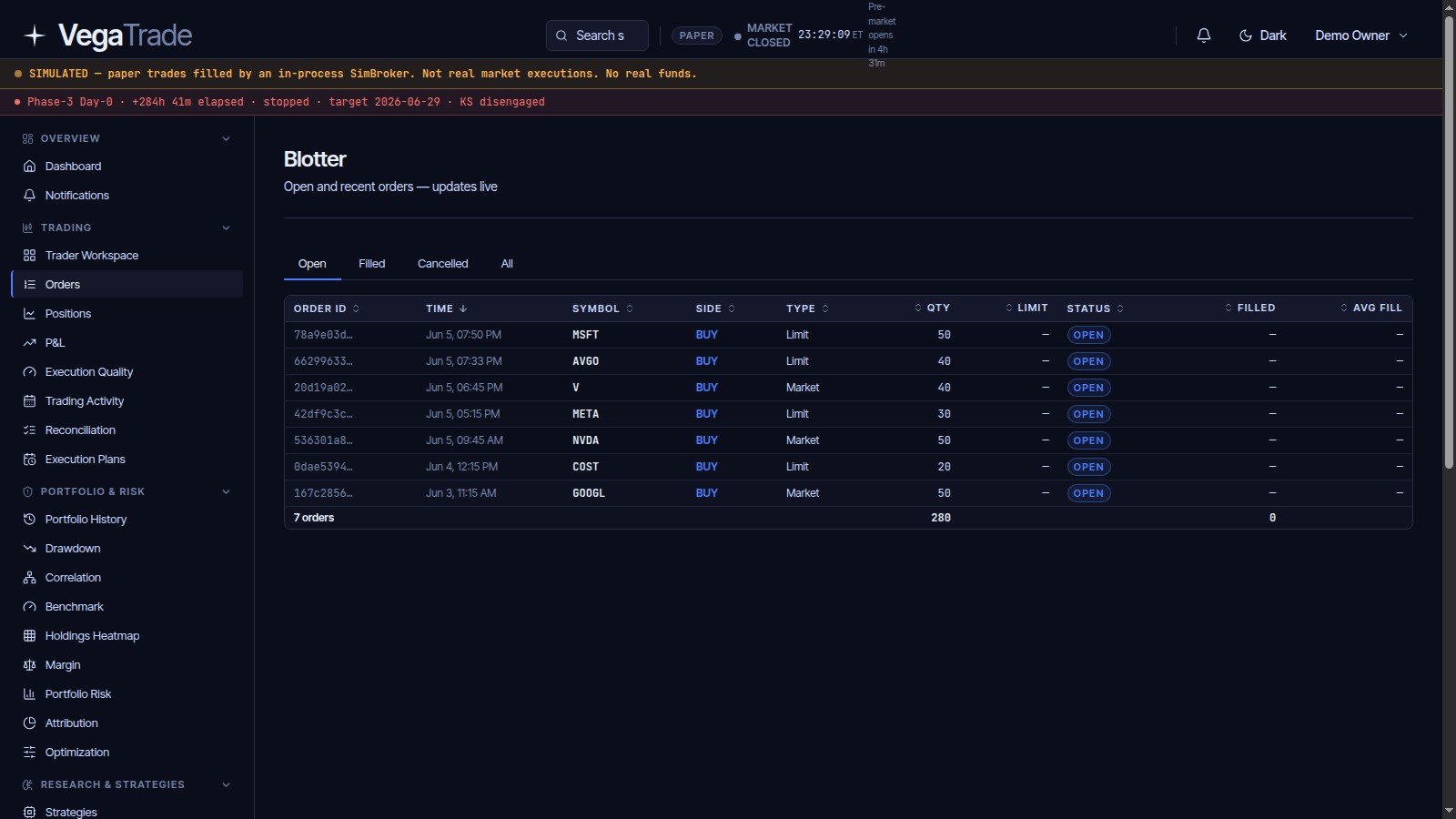
The browser console is a working trading surface, not a reporting veneer: a draggable, symbol-linked trader workspace; a live orders blotter; positions, P&L, drawdown, correlation, margin, and exposure views; performance attribution; portfolio-optimization and execution-plan surfaces; the Tax Center; and the audit-trail explorer. Live state streams over server-sent events; a command palette drives keyboard-first navigation.
The same console carries the governance surfaces an institution expects to see in procurement: kill-switch state, risk-limit utilization against per-tenant gates, model-risk and compliance views, and the chain-of-custody event log — all read-only observe surfaces where observation is the point.
Closing